Tyndale Monument North Nibley
Plaque
ERECTED A.D. 1866
IN GRATEFUL REMEMBRANCE OF
WILLIAM TYNDALE
TRANSLATOR OF THE ENGLISH BIBLE
WHO FIRST CAUSED THE NEW TESTAMENT
TO BE PRINTED IN THE MOTHER TONGUE
OF HIS COUNTRYMEN
BORN NEAR THIS SPOT HE SUFFERED
MARTYRDOM AT VILVORDEN IN
FLANDERS ON OCT 6 1536
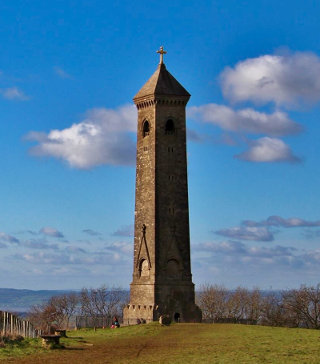
The monument positioned prominently on a hill above the village of North Nibley is dedicated to the martyr William Tyndale. Tyndale's mission was to translate The Bible into English so that ordinary folk could read it for themselves rather than relying on priests for an interpretation. His reward was to be strangled and then burned at the stake. The monument which is 111 feet high was completed in 1866 and officially opened on 6th of November of that year. The reward for climbing the 120 steps is a wonderful view of the Berkeley Vale and the river Severn to the Black Mountains.
The monument is open 24 hours a day every day. The steps up have automatic lighting.
December 2018: Tyndale Bible sells for £37,500.Directions and Access
The Monument is only accessible on foot. There is a bridleway nearby accessible from North Nibley or Wotton-under-Edge. The nearest access point is off the B4060 at 51.659422,-2.376650 on the Cotswold Way. A footpath leads off to the right near the top of this steep track.
A level access from London Road near Wotton-under-Edge is located at 51.644919,-2.356096 on the Cotswold Way.
Parking is limited at both access points. No motor vehicles are allowed on Nibley Knoll. Various footpaths lead to the Knoll and the Monument.
Monument Trust website
If you would like to light up the monument you can do so via the Trust website here.
William Tyndale
Forbidden to work in England, Tyndale translated and printed in English the New Testament and half the Old Testament between 1525 and 1535 in Germany and the Low Countries. He worked from the Greek and Hebrew original texts when knowledge of those languages in England was rare. His pocket-sized Bible translations were smuggled into England, and then ruthlessly sought out by the Church, confiscated and destroyed. Condemned as a heretic, Tyndale was strangled and burned outside Brussels in 1536.The Tyndale Society.
Tyndale's English translation of the New Testament was taken almost word for word into the much praised Authorised Version (King James Bible) of 1611, which also reproduces a great deal of his Old Testament. From there his words passed into our common understanding. People across the world honour him as a great Englishman, unjustly condemned and still unfairly neglected. His solitary courage, and his skill with languages - including, supremely, his own - enriched English history in ways still not properly examined, and then reached out to affect all English-speaking nations.
From the Illustrated London News, November 17th 1866
The monument now erected consists of a tower, 26ft 6in square at the base, and 111ft. high. It is entered on the east side, and contains a staircase leading to a gallery, which is to be adorned with pieces of sculpture, illustrating the chief events in the life of Tyndale and the history of the English Reformation. The tower is surmounted by a large cross of enamel mosaic, the work of Dr. A. Salviati, which is at a great height, and being of gold enamel principally, can be seen at a very great distance on account of the reflection of the light. The architect of the monument is Mr. S.S. Teulon, of Charing Cross. The ceremony of opening the tower was performed by the Earl of Ducie, Lord Lieutenant of the county, on Tuesday week, in the presence of a large assembly. The Rev. J.S. Austin, on behalf of the committee, handed the key to his Lordship, who spoke a few minutes and then unlocked the door, The Rev. Canon Eden, Vicar of Wymondham, delivered an address, in the course of which he recited some appropriate verses, Latin and English, composed by him expressly for the occasion. The Rev. A.G. Cornwall, honorary secretary to the committee, the Rev. Dr. Morton Brown, Mr. Curtis Hayward, and other gentlemen took part in the proceedings. The total cost of the monument has been £1550, and there is a debt of £300, which the committee are now anxious to clear off. The Rev. A.G. Cornwall, Wotton-under-Edge, receiving the subscriptions.
The Gazette January 5th 1974
Standing on a high spot overlooking North Nibley is a famous monument visible from many miles around. Everyone knows it as Tyndale's Monument and it is believed that North Nibley was his birthplace. Strangely, however, although history is full of facts about the martyr his exact birthplace is unknown and there is very little authentic detail about his childhood.
Wherever his exact birthplace, young William Tyndale spent his childhood in the Dursley area before going to Oxford to study Greek.
In about 1522 he could be found living as a tutor to the family of Sir John Walsh of Little Sodbury. He was outspoken in the view that the Bible should be published in English so that it could be studied and understood by even the poorest people in the land. This view prompted much criticism and the persecution against him at Little Sodbury was such that he had to leave the area.
He then devoted his time to his scheme to publish a translation of the Bible. He found it impossible to find any publisher in England willing to undertake such a risky venture so he set sail for Hamburg. From Hamburg he went on to Cologne and continued with his translation. By this time he had many enemies and the activities of these unchristian christians forced him to move further down the Rhine to Worms.
Finally his translation of the Bible was published. The date of this publication is not known, but copies of the issue were circulating in England in 1526, to the enlightenment of many and indignation of others. Tyndale was by then living in Antwerp. Attempts were made to get him back to England. He tried to remain in hiding, but finally he was betrayed and was strangled and then burned at Vilvorden near Brussels, on October 6, 1536.
A memorial to Tyndale was suggested some three centuries later. The project was talked about for some years and finally it was decided to place such a monument on Nibley Knoll which overlooks the village (at that time it was thought that North Nibley was Tyndale's birthplace). The foundation stone was laid on May 29th, 1863 by the Hon. Colonel Berkeley. The work was carried on from that time and the memorial was finally inaugurated by the Earl of Ducie on Tuesday, November 6, 1866.
The memorial is a cenotaph consisting of a square tower 26' 6" sqaure at the base rising to 22ft and above that diminishing by 2ft. It is 111ft high exclusive of the terminal which is a small but elegant gilded cross. The entrance is in the east side and within is a staircase ascending to the gallery.
The cardinals were to be adorned with sculptures, the first representing Tyndale leaving Sodbury, the second his conference with John Frith, the third his betrayal at Antwerp and the fourth his martyrdom. The tower is terminated by a machiolated cornice sustaining a pyramidal roof, vaulted within.
It is constructed of stone from Hampton Quarry, near Stroud. Total cost £1,550.
When the monument was inaugurated the day was declared a public holiday in Dursley and Wotton. Each of the workmen who had worked on the monument's construction was presented with a beautifuly bound volume of the authorised version of the Bible -- an appropriate gift to mark the occasion. At least one of these Bibles is still a cherished family heirloom for a Wotton-under-Edge family.
The Trustees of The Tyndale Monument and Bruton Charities
Mr Mark Bailey
Mr Roland Brown (NNPC)
Mr George Macklin - Chair
Mr Ron McAllister
Mr David Palmer
Ms Carolyn Timbrell
Mr Stephen Timbrell
Mrs E Hicks - Secretary
150th anniversary celebration on 1st October 2016
The first performance of 'Word of God', a work composed by Helen Fink, director of North Nibley Community Choir, to celebrate 150 years of the Tyndale Monument's existence. The words of the piece are taken from the ceremony of the inauguration of the Monument in 1866 written by the Rev. Robert Eden. It tells the story of William Tyndale's translation of the Bible, the final words read '...the light shines in England. The shut bible opens'.
Helen Fink's work formed part of a concert devised by Emily White, Professor at the Guildhall School of Music and Drama, London which includes music from the present moment travelling back in time through the 500 years to Tyndale's birth. The musicians were: Aeris Brass, a trombone quartet who also play sackbut; folk fiddler and baroque violinist Morag Johnston as well as the North Nibley Community Choir. Selected poems of U.A. Fanthorpe and Brian Nisbet were read by the poet R.V. Bailey.
The concert was at St Martin's Church, North Nibley at 7pm on Saturday, October 1st. Tickets £8 (£3).
William Tyndale - further information
Find out about William Tyndale here.